
Random Hardware Failures vs. Systematic Failures – Why Both Matter for Functional Safety

18 Nov 2026
And How IEC 61508 Distinguishes between the Two
When assessing Functional Safety, there is often a strong focus on the numbers. Probability of dangerous failure per hour (PFH), probability of failure on demand average (PFDavg), failure rates, diagnostic coverage, and safe failure fraction are all important measures, but they only tell part of the story.
A product can achieve a safety integrity level (SIL) 3 hardware reliability target and still fail dangerously due to a design, software, or specification error. Understanding why requires an appreciation of the difference between random hardware failures and systematic failures. This distinction sits at the heart of IEC 61508 and is frequently misunderstood when reviewing Functional Safety certificates.
This is why IEC 61508 distinguishes between two fundamentally different types of failure: random hardware failures and systematic failures. Understanding the difference is particularly important when designing a safety-related product, assessing a SIL claim or reviewing a Functional Safety certificate.
| Random Hardware Failures | Systematic Failures |
| Component wear-out | Specification errors |
| Electrical overstress | Design errors |
| Manufacturing defects | Software bugs |
| Statistical behaviour | Cause-and-effect behaviour |
| Measured using PFH/PFDavg | Controlled through lifecycle processes |
| Addressed using reliability techniques | Addressed using Systematic Capability |
Random Hardware Failures
Random hardware failures are physical failures that can occur during the operating life of a component or system. These may result from semiconductor failures, component defects, electrical overstress, ageing, or environmental influences.
The important characteristic of random hardware failures is that they can generally be treated statistically. Using appropriate component failure rate data and reliability analysis, we can estimate the probability of dangerous hardware failures occurring. This is where techniques such as failure modes, effects, and diagnostic analysis (FMEDA) and reliability prediction are used, together with measures such as PFH, PFDavg, safe failure fraction, diagnostic coverage and hardware fault tolerance.
These analyses provide evidence that random hardware failures have been sufficiently controlled for the required integrity level. However, achieving the required PFH or PFDavg does not, on its own, demonstrate that a product is suitable for a particular SIL.
Systematic Failures
Systematic failures are different because they are not caused by the random physical failure of a component. Instead, they originate from errors introduced during the specification, design, implementation, verification, operation, or maintenance of the product.
An incorrect safety requirement is a systematic fault. So is a software coding error, an incorrect assumption within an FMEDA, inadequate testing, or a poorly controlled design modification. The key difference is that these failures cannot simply be addressed through reliability calculations.
Consider a software defect that causes a safety function to behave incorrectly under a particular operating condition. The hardware could have an extremely low probability of dangerous failure per hour (PFH), but that does nothing to remove the software defect. Every time the relevant condition occurs, the same incorrect behaviour may occur.
This is why a strong set of hardware reliability figures does not automatically demonstrate Functional Safety.
What Is Systematic Capability?
IEC 61508 addresses systematic failures through the concept of systematic capability (SC).
Systematic capability provides confidence that appropriate processes, methods, techniques, and verification activities have been applied throughout development to prevent systematic faults from being introduced and to identify those that do occur.
Rather than only asking “How reliable is the hardware?”, we also need to ask questions such as:
- Were the safety requirements correctly defined?
- Were appropriate design and verification techniques applied?
- Was the software developed to a suitable level of rigour?
- Were modifications and configurations properly controlled?
- Can requirements be traced through design, implementation and testing?
These questions require evidence from the complete Functional Safety lifecycle. For modern programmable and software-driven products, this can be every bit as important as the hardware reliability calculation.
Functional Safety Is a Lifecycle Activity
One of the most important aspects of IEC 61508 is that Functional Safety is not simply a calculation performed once the product has been designed – Functional Safety needs to be managed throughout the lifecycle.
This includes:
- establishing appropriate roles and responsibilities
- demonstrating competence
- planning safety activities
- defining verification and validation activities
- maintaining configuration control and ensuring modifications are appropriately reviewed
This matters because many systematic failures occur because something was missed, incorrectly specified, incorrectly implemented or inadequately verified.
A strong Functional Safety Management process provides the framework for controlling these risks. The same principle applies to the hardware and software development lifecycles. Hardware development should demonstrate that safety requirements have been appropriately allocated, the architecture has been assessed, reliability analysis has been performed, and suitable verification and validation evidence exists.
For software, the lifecycle becomes particularly important. Software safety requirements, architecture, detailed design, coding standards, static analysis, testing, traceability and configuration management may all form part of the evidence needed to support the claimed SIL.
The level of rigour applied should be appropriate to the required integrity level. Simply meeting a quantitative hardware target does not demonstrate that these systematic aspects have been adequately addressed.
Understanding What Has Actually Been Certified
This distinction becomes particularly important when reviewing Functional Safety certificates.
Not all Functional Safety certificates assess the same scope. Some assessments focus primarily on hardware integrity and architectural constraints, while others include software development processes, Functional Safety management and systematic capability. Understanding exactly what has been assessed is critical before relying on a SIL claim.
This is why the scope of certification and supporting assessment documentation can be just as important as the certificate itself.
A certificate may provide valuable evidence that the hardware meets the quantitative requirements associated with a particular SIL while providing much more limited evidence regarding systematic integrity. Understanding that distinction is essential when selecting a component for use within a safety-related system.
What Does This Mean in Practice?
When selecting or integrating a safety-related product, it is important not to rely solely on a SIL claim, PFH value, or hardware failure rate. Instead, the available evidence should demonstrate appropriate control of both random hardware failures and systematic failures.
This becomes increasingly important as safety systems become more software-driven, configurable, and connected. Programmable controllers, intelligent sensors, communication-based safety systems, and other complex electronic products can contain significant systematic complexity even where the underlying hardware reliability is excellent.
The same principle applies when manufacturers are developing products for Functional Safety certification. Achieving the required hardware reliability target is important, but it should form part of a wider Functional Safety lifecycle rather than being treated as the complete demonstration of compliance.
Ultimately, a SIL claim is only meaningful when the different failure mechanisms that could prevent the safety function from operating correctly have been appropriately addressed. Random hardware integrity tells us how likely the hardware is to fail. Systematic capability tells us how confident we can be that the product was developed correctly in the first place.
Need Support with Functional Safety?
Understanding exactly what a Functional Safety certificate, SIL claim or safety manual demonstrates is not always straightforward. Intertek's Functional Safety specialists support manufacturers and end users with product assessments, Functional Safety lifecycle reviews, independent gap analyses and certification activities against standards including IEC 61508, ISO 26262, IEC 62061 and ISO 13849.
If you need support developing a Functional Safety product, understanding an existing certification or independently reviewing a SIL claim, contact our team to discuss your requirements.
Download our Random Hardware Failures vs. Systematic Failures of functional safety infographic.

You may be interested in...
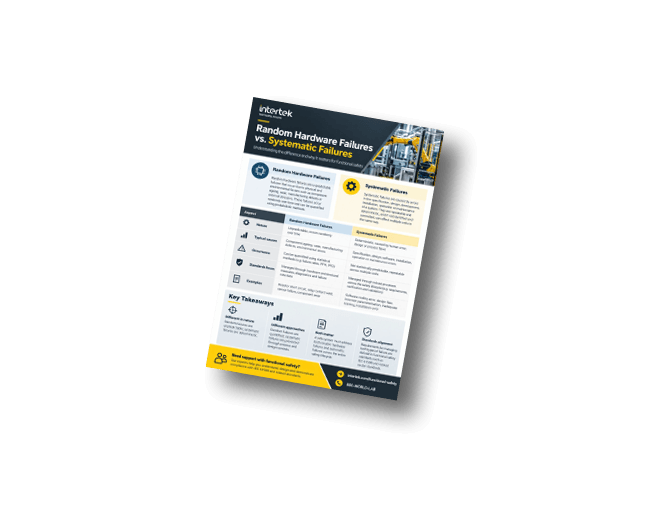
Functional Safety Essentials: Random and Systematic Failures Explained | Infographic
Get help understanding the differences between Random hardware failures and Systematic Failures and why it matters to Functional Safety.

Functional Safety Testing & Certification
From early design stages through to production, our modular FS solutions provide flexible options for manufacturers, and our FS Mark provides stakeholders with visibility for products they purchase, install, or utilize in operations.