
Intertek offers comprehensive Inverter Testing, Evaluation and Certification services for solar and grid supported inverters
Power conversion equipment sits at the center of today's energy systems. Whether you're developing solar inverters, battery energy storage inverters, hybrid inverters, or bidirectional power conversion systems, Intertek provides the testing, certification, and grid compliance services needed for North American and global market access.
Modern energy systems rely on sophisticated inverter technology to safely convert, control, and distribute electrical power. Manufacturers that demonstrate compliance with electrical safety, EMC, grid interconnection, cybersecurity, functional safety, and performance requirements can enter many global markets.
Intertek provides end-to-end support throughout product development—from design reviews and pre-compliance testing through certification, grid code validation, and ongoing regulatory support.
Inverter Evaluation Capabilities
- Safety Testing & Certification
- Inverters, Converters, Charge Controllers, and Interconnection System Equipment (ISE)
- Grid-connected and Stand-alone Applications
- Bidirectional and Multimode Inverter Testing
- Medium Voltage Power Conversion Evaluation such as Solid State Transformer
- DER Communication Protocol Testing
- Efficiency Testing
- Global Grid Compliance Testing including Regional SRD Requirements
- European Regulation 2016/631 Requirement For Generators (RFG)
- Utility Grid Interconnected Bidirectional Electric Vehicle Supply Equipment / Interconnection Systems Equipment (BEVSE/ISE) Evaluated to UL 1741 Supplement SC
- Power Control System (PCS) Testing
- Functional Safety Evaluation
- Cybersecurity Evaluation
- Interconnection Integrity (EMC) testing
- And more
Testing & Certification Services
Intertek offers integrated testing, certification, and engineering services that support the complete product development lifecycle—from early design validation through certification, regulatory compliance, and global market access.
Demonstrate compliance with North American and international electrical safety requirements for grid-connected and standalone power conversion equipment. Intertek evaluates construction, electrical safety, abnormal operation, thermal performance, protective functions, markings, and installation requirements to support product certification.
Key applicable standards include:
- UL 1741
- CSA C22.2 No. 107.1
- UL 2877
- UL 347A
- UL/CSA/IEC 62109-1 & CSA/IEC 62109-2
- IEC 62477-1 & IEC 62477-2
- UL 3141
- UL 1699B
Verify that inverter products meet utility and regulatory requirements for safe operation on the electrical grid. Testing validates advanced inverter functionality required for distributed energy resources (DERs), helping manufacturers achieve utility acceptance and market access.
Capabilities include:
- IEEE 1547 & IEEE 1547.1 compliance testing
- UL 1741 Supplement SA & SB
- CSA C22.3 No. 9
- California Rule 21 (Source Requirement Document (SRD) to IEEE 1547-2018 requirements)
- Hawaii Rule 14H (SRD to IEEE 1547-2018 requirements)
- ISO New England (SRD to IEEE 1547-2018 requirements)
- PRC-024-3 (SRD to IEEE 1547-2018 requirements)
- Other country grid codes type testing (VDE 4105, VDE 4110, VDE 4120, VDE 4130, VDE 0124-1-1, AS/NZS 4777.2, PO 12.3, CEI 0-21, CEI 0-16, DEWA and many more) with ISO 17025 and ISO 17065 capability
- Utility-specific interconnection requirements
- Regional and international grid code validation
- Witness testing for utility acceptance
Typical evaluations include:
- Anti-islanding
- Voltage and frequency ride-through
- Phase change ride through
- Volt/VAR control
- Volt/Watt control
- Watt/VAr control
- ROCOF control
- Function priority
- Frequency/Watt response
- Reactive power capability
- Other Grid support functionalities
Evaluate electromagnetic emissions and immunity to demonstrate reliable operation in real-world electrical environments while satisfying regulatory requirements for global markets.
Testing includes:
- IEC 61000 series
- FCC requirements
- ICES requirements (Canada)
- Conducted and radiated emissions
- Electrostatic discharge (ESD)
- Surge immunity
- Electrical fast transient (EFT)
- Voltage dips and interruptions
- Radiated and conducted immunity
Assess long-term durability and performance under environmental conditions encountered during transportation, installation, and field operation.
Capabilities include:
- High and low temperature testing
- Temperature cycling
- Humidity exposure
- Thermal shock
- Vibration and mechanical shock
- Salt fog and corrosion resistance
- Dust and water ingress (IP testing)
- UV exposure
- Outdoor environmental conditioning
Support the safe development of programmable electronic control systems used in modern inverter platforms and energy storage applications.
Applicable standards include:
- IEC 61508 series
- IEC 62061
- ISO 13849 (where applicable)
- UL 1998
- UL 991
- UL/CSA/IEC 60730-1 Annex H
Services include:
- Functional safety assessments
- Safety lifecycle support
- Software evaluation
- Hardware architecture reviews
- Safety integrity analysis
- Independent third-party assessment
Smart Inverters comes with Interoperability capability. Which requires common communication protocol to be able to communicate with grid servers. California Rule 21 requires IEEE 2030.5 as default communication protocol for the inverters connected to grid either using DER gateway or DER Aggregator. IEEE 1547-2018 allows any one of the three protocols to be used namely IEEE 2030.5, Sunspec Modbus and DNP3.
Some test standards include:
- CSIP testing (SunSpec developed IEEE 2030.5 Common Smart Inverter Protocol)
- Resolution E-5000 (for End-to-End communication check)
- IEEE 1547.1-2020 (Interoperability testing using any one of the protocols mentioned in IEEE 1547-2018)
UL 1741 Supplement SC V2G AC Evaluation of BEVSE/ISE
Recent development in grid support activities and Power control system has led to development of requirements for the bidirectional BEVSE/ISE to safely export power to grid using EV onboard inverter compliant to SAE J3072.
UL 1741 SC V2G AC Evaluation includes:
- Tests on BEVSE/ISE BEVID interrupting device
- Test for voltage disturbance oversight
- Test for frequency disturbance oversight
- BEVSE/ISE withstand tests
- Interconnection integrity
- Rate of change of frequency (ROCOF) susceptibility test
- Phase change ride through (PCRT) susceptibility test
- Power supply grid support ride through test (PSGSRT)
- Enter service (ES) oversight
- Protection from unauthorized export
- Continuation of prohibit export (disable permit service) following a BEVSE/ISE power Cycle
- Inclusion EV authorized list check
- EV Configuration Information and Management Information evaluation
- BEVSE/ISE Configuration Information and Management Information
Verify that inverter products operate efficiently, reliably, and in accordance with performance expectations across a range of operating conditions.
Power Quality evaluation includes:
- Conversion efficiency
- Thermal performance
- Power quality
- Harmonic distortion (THD)
- Continuous operation and endurance testing
As energy systems become increasingly connected, cybersecurity plays an important role in protecting products, communications, and grid infrastructure. Intertek helps manufacturers identify vulnerabilities and demonstrate compliance with recognized cybersecurity requirements.
Standards include:
Capabilities include:
- Vulnerability assessments
- Secure communications evaluation
- Software and firmware review
- Network security testing
- Connected device assessments

Inverter Testing and Certification - Frequently Asked Questions (FAQs)
UL 1741 is the product safety standard for inverters, converters, controllers, and interconnection system equipment used with distributed energy resources. IEEE 1547 establishes the technical performance and operational requirements for how distributed energy resources interconnect and interact with the electric grid. Products intended for use in North America typically need to demonstrate compliance with both safety and grid interconnection requirements.
Certification requirements depend on the intended application, installation location, and target market. Grid-connected inverters typically require certification to recognized safety and interconnection standards before they can be accepted by utilities or installed under applicable electrical codes. Requirements may differ for utility-scale, commercial, residential, off-grid, or export-only systems.
UL 1741 Supplement SB defines the testing procedures used to verify compliance with the advanced inverter functions required by IEEE 1547-2018. These evaluations include voltage and frequency ride-through, voltage regulation, reactive power control, frequency response, communications, and other grid support capabilities required by many North American utilities.
Grid-connected inverters may require evaluations beyond traditional grid-following inverter testing. Depending on the application, testing can include stability under changing grid conditions, fault response, black start capability, islanded operation, interoperability, control performance, power quality, and applicable grid code requirements. Testing programs are typically customized based on the product's intended use.
Yes. Intertek offers design reviews, engineering evaluations, and pre-compliance testing that help manufacturers identify potential issues before formal certification begins. Early testing can reduce redesigns, improve project timelines, and help streamline the certification process.
In some cases, yes. Many manufacturers leverage testing performed to internationally recognized IEC standards or participate in programs such as the CB Scheme to support certification in multiple countries. However, individual markets often have additional national standards, utility requirements, or regulatory approvals that must also be addressed.
Hybrid battery inverters often require compliance with multiple standards covering electrical safety, grid interconnection, energy storage systems, electromagnetic compatibility, and battery integration. Applicable requirements may include UL 1741, IEEE 1547, CSA C22.2 No. 107.1, IEC 62109, IEC 62477-1, UL 9540, UL 9540A, and additional regional requirements depending on the installation.
Project timelines vary based on product complexity, design maturity, testing scope, laboratory scheduling, and the number of markets being pursued. Products that have undergone pre-compliance testing and design review often move through the certification process more efficiently than products entering formal testing for the first time.
Manufacturers should consider pre-compliance requirements early in the product development process. Incorporating applicable standards during design can reduce engineering changes, shorten certification timelines, and help accelerate market entry. Early collaboration with a testing and certification partner can also identify potential compliance challenges before prototype testing begins.
Yes. Intertek supports manufacturers developing residential, commercial, industrial, and utility-scale power conversion equipment. Our capabilities include safety testing, grid code compliance, environmental testing, EMC, cybersecurity, functional safety, and performance evaluations for a wide range of inverter technologies and distributed energy resources.
Intertek tests and certifies a broad range of power conversion equipment, including solar string inverters, central inverters, microinverters, battery energy storage power conversion systems (PCS), hybrid inverters, bidirectional inverters, EV power conversion equipment, microgrid inverters, and other distributed energy resource technologies.
Certification ensures that SSTs meet established safety, performance, and compliance standards before deployment. Given their complexity, SSTs must be evaluated across multiple domains. SSTs are comprised of multiple components that form or operate at a system level. It integrates different components and technologies including high voltage, high power, and complex power electronics. Failure in such systems can have serious consequences.
Early engagement with a certification body such as Intertek can streamline certification by aligning product design with applicable standards, enabling pre-compliance testing, and establishing robust documentation and traceability from the outset.
While SSTs standards are still evolving, certification generally relies on established frameworks for power electronics and transformer systems.
UL 1741, together with IEEE 1547/1547.1, addresses power conversion, grid interconnection, and interoperability. For MV applications (>1,000 Vac or 1,500 Vdc), UL 2877 and UL 347A cover power conversion equipment up to 38 kV. IEC 62477-2 may apply outside North America. The SST’s high-frequency transformer is evaluated to applicable transformer standards.
AI can transform the power grid by improving efficiency, reliability, and sustainability. SSTs can provide real-time grid data, enabling AI to optimize energy flows, predict supply and demand, and better integrate renewable energy. Together, SSTs and AI can support a smarter, more sustainable, and cost-effective power grid.
From a product certification perspective, SSTs can support AI and data centers, with key areas including electrical safety, grid interconnection, power quality, functional safety, EMC, and system integration.
Related Links
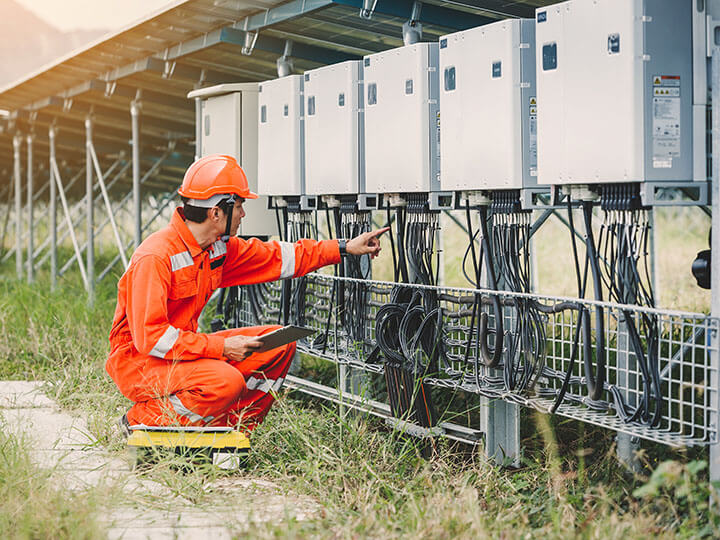
Inverter Testing and Evaluation for UL 1741
Intertek offers comprehensive Inverter Testing, Evaluation and Certification services for solar and grid supported inverters to UL 1741
06 Aug 2026
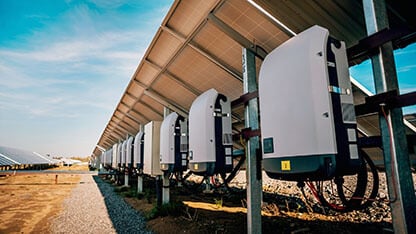
U.S. FCC Expands the Covered List to Include Foreign-Produced Power Inverters
What Manufacturers Need to Know
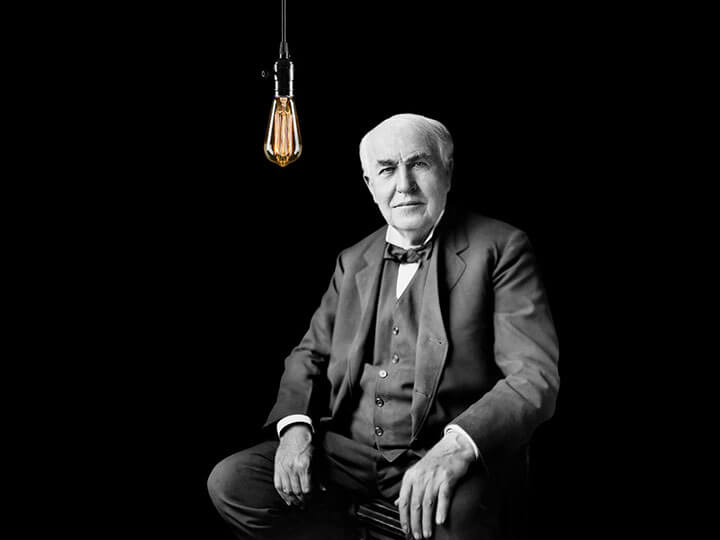
Thomas Edison’s Legacy
Thomas Edison and innovation go hand in hand. His ground breaking inventions in the 19th century introduced the world to sound recording and playback, motion pictures, electric light, and the practicality of product testing.
Knowledge Center
Quick Facts for Solar Thermal Products Fact Sheet
Building Integrated PV Testing Fact Sheet
Solar Thermal System Testing Fact Sheet
Electroluminescence Imaging of PV Modules Fact Sheet
PV Module Testing, Certification & Declarations Fact Sheet
Photovoltaic Panel & Module Compliance to IEC 61730
UN 38.3 and the Transportation of Lithium Batteries: A Webinar Series
Smart Inverter Communication Protocol: Sunspec CSIP & IEEE 2030.5 Compliance Webinar
Updated FCC Approval Process Webinar

