
GMP nitrosamine impurities testing, method development and validation to support risk assessments, regulatory compliance and pharmaceutical quality control.
Low level and robust nitrosamine testing is integral to the control of nitrosamine impurities in human drugs, which remains a critical focus for pharmaceutical manufacturers and global regulatory authorities, making sensitive and reproducible nitrosamine analysis an essential component of pharmaceutical development, manufacturing and quality control. The presence of N-nitrosodimethylamine (NDMA) in valsartan APIs was first brought to prominence in 2018 and was quickly followed by concern around the presence of other nitrosamines in pharmaceuticals including NDEA, NEIPA, NDIPA, NDBA and NMBA across a range of pharmaceutical products. Since then, regulators have strengthened expectations for comprehensive nitrosamine impurity risk assessment, confirmatory nitrosamine analysis with robust control strategies throughout the product lifecycle.
Whether supporting product development, regulatory submissions, manufacturing changes, stability programmes or routine GMP quality control, outsourced nitrosamine testing provides the reliable analytical data needed to identify, quantify and control nitrosamine contamination, helping pharmaceutical companies demonstrate patient safety, maintain global regulatory compliance and reduce the risk of costly product recalls. The precision of such testing is vital for identifying trace levels of nitrosamines and implementing appropriate measures to mitigate their presence and maintain the integrity of pharmaceutical products.
Our Nitrosamine Testing Services
Our nitrosamine testing labs provide accurate and sensitive testing that is crucial for detecting and quantifying these impurities in pharmaceutical products. Working to all major guidance, including the U.S. Food and Drug Administration (FDA), the European Medicines Agency (EMA) and the USP <1469> Nitrosamine Impurities chapter, we use of highly sensitive, validated nitrosamine detection methods capable of reaching detection at trace levels below established acceptable intake (AI) limits.
Following both the EMA guidance and the nitrosamine FDA guidance, we select analytical methods based on the specific drug substance, drug product matrix, and target nitrosamines, rather than relying on a single universal method.
We are experienced in custom nitrosamine testing method development and validation for nitrosamine impurity analysis in accordance with ICH Q2, where implemented), with validation appropriate to the stage of development. We use orthogonal (independent) confirmatory methods where there is a risk of analytical interference or false-positive results. We use nitrosamine detection methods including Liquid Chromatography - Mass Spectrometry/Mass Spectrometry (LC-MS/MS) and Liquid Chromatography–High Resolution Mass Spectrometry (LC-HRMS), Gas Chromatography - Mass Spectrometry GC-MS), Gas Chromatography - Mass Spectrometry/Mass Spectrometry (GC-MS/MS) and Headspace GC-MS approaches.
LC-MS/MS and LC-HRMS
LC-MS/MS is highly sensitive and offers excellent specificity for quantifying nitrosamine impurities present at trace levels. We use this for routine GMP nitrosamine analysis, method validation and regulatory submissions, allowing reliable detection at concentrations well below acceptable intake (AI) limits. The same tandem detection approach is utilized with HRMS, as established in FDA published methodologies. Intertek primarily utilizes LC-HRMS for determination of nitrosamines.
LC-HRMS
LC-HRMS is ideal for the identification of unknown nitrosamine impurities with high mass accuracy. We use it as a confirmatory technique alongside other methods, and it is useful when analytical interferences are present or when structural confirmation is required.
GC-MS/MS
GC-MS/MS is ideal for the analysis of volatile and semi-volatile nitrosamines, including NDMA testing and NDEA, with excellent sensitivity. Overall, GC has proved extremely useful for some difficult projects, helping us to present an alternative and successful route to avoiding challenges associated with liquid chromatography co-elution of NDMA and DMF, as well as other potential interferences, where present.
Headspace GC-MS
Headspace GC-MS is effective for detecting residual volatile nitrosamines in pharmaceutical materials while reducing sample preparation demands and any sample matrix interference. It is particularly suitable for the analysis of volatile impurities and has been adopted in FDA methodologies for the determination of nitrosamines in selected APIs and drug products.
This flexibility in platform approaches means we can apply sample and nitrosamine-specific, tailored analytical solutions that are highly relevant for your nitrosamine testing needs.
Why Choose Intertek for Nitrosamine Testing?
- 30+ years of pharmaceutical analytical expertise supporting global pharmaceutical and biotechnology companies with drug development, quality control, regulatory compliance and lifecycle management helping them to demonstrate compliance with FDA, EMA, ICH and USP expectations
- Global network of GMP laboratories delivering trusted analytical testing services to support pharmaceutical manufacturers worldwide with responsive, scalable outsourcing solutions.
- Comprehensive nitrosamine testing capabilities using highly sensitive analytical techniques including LC-MS/MS, LC-HRMS, GC-MS/MS and Headspace GC-MS for quantification of trace-level nitrosamine impurities.
- Specialist expertise in NDSRIs (Nitrosamine Drug Substance-Related Impurities) testing with proven experience in the identification, characterisation and quantification of compound-specific nitrosamines at ultra-trace levels.
- Bespoke analytical method development and validation for APIs, drug products and complex formulations, delivering fit-for-purpose methods that meet global regulatory expectations.
- Experts in challenging pharmaceutical impurity analysis, helping overcome low detection limits, complex sample matrices, analytical interferences and the identification of unknown impurities.
- Integrated toxicology consultancy with experienced scientists providing toxicological risk assessments for nitrosamines, elemental impurities (ICH Q3D), extractables and leachables, residual solvents, process impurities and other potentially genotoxic impurities.
Identification and Quantification of Nitrosamine Drug Substance-Related Impurities (NDSRIs)
Nitrosamine drug substance-related impurities (NDSRIs) are a class of nitrosamines that can form the chemical structure of an active pharmaceutical ingredient (API), often when amine-containing drug substances react with nitrosating agents during manufacturing, storage or packaging. There is increasing focus in the sector on NDSRIs with analytical methods (primarily LC approaches) to identify (LC-HRMS) and quantify (LC-MS/MS). Our scientists develop sensitive analytical methods necessary for detecting NDSRIs, supporting risk assessments, monitoring stability or establishing control strategies.
Monitoring NDSRIs During Stability
During shelf-life and stability studies, anticipated NDSRIs can be effectively monitored at suitable timepoints using predominantly LC-MSMS (or GC-MS/MS as appropriate). Coupled with a global ICH Stability storage facility network, our team is adept at method development and validation for this purpose.
Analytical Testing to Support Nitrosamine Risk Assessments
Our scientists are experienced in supporting nitrosamine risk assessments with the confirmatory data needed to determine whether nitrosamine impurities are present and whether they are observed at levels below acceptable intake (AI) limits as per regulatory guidance. At Intertek, we develop and validate sensitive, fit-for-purpose analytical methods using LC-MS/MS, LC-HRMS, GC-MS/MS and Headspace GC-MS to identify and quantify both established nitrosamines and nitrosamine drug substance-related impurities (NDSRIs) in APIs and drug products. Our GMP analytical labs support every stage of the risk assessment process, from initial product evaluation and manufacturing changes to stability studies, regulatory submissions and the implementation of long-term nitrosamine control strategies across the product lifecycle.
Discover how our sensitive nitrosamine testing services can support your organisation
Whether you require routine GMP nitrosamine testing, bespoke method development, or analytical support for nitrosamine risk assessments, Intertek's pharmaceutical scientists can provide the expertise and regulatory insight to help you meet global compliance requirements. Contact our team today to discuss your analytical testing requirements and discover how our nitrosamine testing services can support your product development, quality control and regulatory programmes.
How nitrosamine impurities are formed?
Nitrosamines may form during the manufacture or storage of pharmaceutical products when secondary amines (or precursors to secondary amines) react with nitrosating agents, such as nitrites, under favourable conditions including acidic pH, elevated temperature, or in the presence of water. Potential sources of these precursors include the active pharmaceutical ingredient (API), reagents, solvents (e.g. dimethylformamide [DMF] and N-methylpyrrolidone [NMP]), catalysts, impurities, degradation products, and excipients containing trace levels of nitrite. Drug manufacturing processes, particularly wet granulation and formulation with nitrite-containing excipients, may also create conditions that promote nitrosamine formation. These mechanisms are recognised in both FDA and EMA guidance as key considerations in evaluating nitrosamine risk.
What should be considered in a nitrosamine risk assessment?
A nitrosamine risk assessment should take a science- and risk-based approach, evaluating the API structure, synthetic route, manufacturing process, raw materials, excipients, process parameters, and the potential for interactions between amine-containing compounds and nitrosating agents. The assessment should also consider the effectiveness of process controls and purification (including theoretical purge where appropriate), identify opportunities to minimise precursor formation or exposure, and determine whether confirmatory analytical testing is required. Consistent with FDA and EMA guidance, the outcome of the risk assessment should support an appropriate control strategy, with analytical testing and ongoing monitoring used to demonstrate that nitrosamine levels remain below established acceptable intake limits throughout the product lifecycle.
What should be considered in a nitrosamine risk assessment?
A nitrosamine risk assessment should take a science- and risk-based approach, evaluating the API structure, synthetic route, manufacturing process, raw materials, excipients, process parameters, and the potential for interactions between amine-containing compounds and nitrosating agents. The assessment should also consider the effectiveness of process controls and purification (including theoretical purge where appropriate), identify opportunities to minimise precursor formation or exposure, and determine whether confirmatory analytical testing is required. Consistent with FDA and EMA guidance, the outcome of the risk assessment should support an appropriate control strategy, with analytical testing and ongoing monitoring used to demonstrate that nitrosamine levels remain below established acceptable intake limits throughout the product lifecycle.
What is in the USP <1469> Nitrosamine Impurities chapter?
USP <1469> Nitrosamine Impurities provides a science- and risk-based framework for identifying, assessing, controlling, and testing nitrosamine impurities in pharmaceutical drug substances and drug products. The chapter requires manufacturers to perform comprehensive risk assessments across the drug substance, excipients, manufacturing process, packaging, and product stability to identify potential sources of nitrosamine formation, establish appropriate control strategies, and demonstrate that nitrosamine levels remain below compound-specific Acceptable Intake (AI) limits. Analytical methods includes HPLC-HRMS, HPLC-MS/MS, GC-MS/MS, and headspace GC-MS, with validated methods designed to detect trace levels of common nitrosamines such as NDMA, NDEA, NDIPA, NEIPA, NMBA, NMPA, and NDBA. Nitrosamine limits are based on toxicological AI values expressed in nanograms per day (ng/day) and converted into product-specific concentration limits (ppm) according to the maximum daily dose, ensuring patient exposure remains within acceptable carcinogenic risk levels.
Related Links
Intertek Pharmaceutical Services
P.O. Box 470
291 Route 22 East
Salem Industrial Park
Whitehouse, NJ 08888
USA
Download our Sample Size and Pricing Guide (PDF)
Download our Pharmaceutical Testing brochure (PDF)
Download our Intertek Pharmaceutical Services Brochure
Download our Custom Extractables and Leachables Solutions Brochure
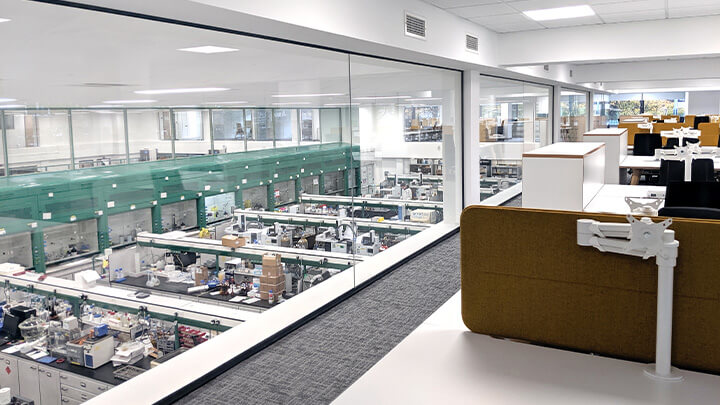
Intertek Pharmaceutical Services Manchester
P.O. Box 42
Hexagon Tower
Blackley
Manchester, M9 8ZS
United Kingdom
For location use: M9 8GQ
Intertek Pharmaceutical Services India
Analytical Testing, Auditing and Process & Powder Safety Testing US FDA, MH-FDA, CDSCO, cGMP, GLP & NABL Certified Laboratory
Intertek Pharmceutical Services India
F-Wing, Tex Center, Chandivali Farm Road,
Chandivali, Andheri (E) Mumbai,
Maharashtra - 400072
T: +91-22-4245 0100
E: pharma-asia@intertek.com
Download Brochure
NEW:
Q&A: Leachables Assessments for Biologic Drugs
Guide: Pharmaceutical Packaging Assessment Following USP <1663> and USP <1664> Guidance
Guide: Evaluating the Durability and Integrity of Pharmaceutical Glass Packaging
Q&A: Takeaways from the Draft ICH Q3E Guidance
DOWNLOAD OUR NITROSAMINE RESOURCES
FACTSHEET: Analytical Methods for Nitrosamine Impurity Analysis
ARTICLE: A Strategic Approach to Nitrosamine Screening in Drug Products

Pharmaceutical News & Events
- PRESS RELEASE: Intertek expands one of Europe's largest GMP pharmaceutical stability storage facilities
- PRESS RELEASE: Expansion of capacity with acquisition of new facility in Melbourn, Cambridge
- PRESS RELEASE: Intertek partners with CrystecPharma to advance formulation science and accelerate development for dry powder inhalers
- Blog: Optimising Quality in Pharma Supply Chains
- Discover our Audit Live Tool for direct access to our scheduled audits
- Extractables/Leachables Lab Tour - Request access
- Medical Device Extractables & Leachables Studies
- Rapid Determination of Low/Trace Level Benzene in Pharmaceutical Excipients and Finished Products
